
The Invisible Work of Keeping a Family on Schedule
There is a kind of work that rarely appears on a to-do list.
It doesn’t involve sitting at a desk, clocking in, or receiving a paycheck. There is no official job title for it, and there certainly isn’t a vacation policy.
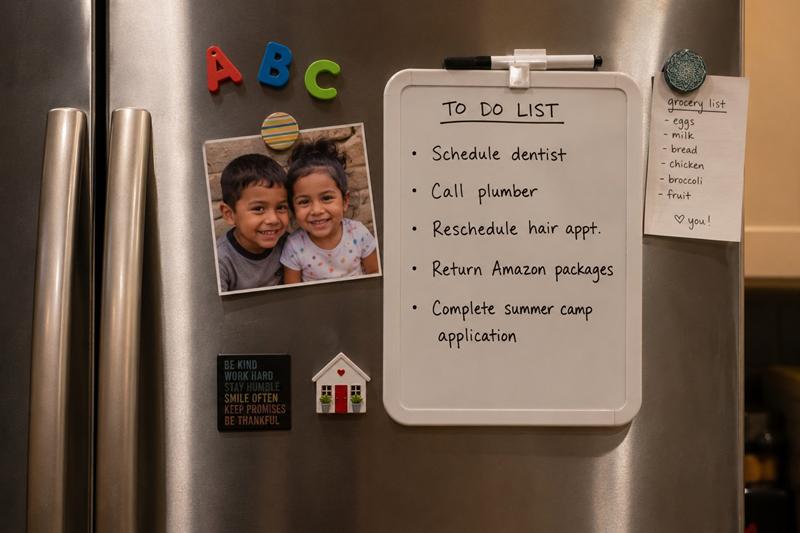
Yet someone has to remember that the dentist appointment is Tuesday at 3:30. Someone has to notice that the dog is almost out of medication. Someone needs to remember which child has an early dismissal, whose permission slip still needs to be signed, when the electric bill is due, and whether there is enough milk for breakfast.
It is the invisible work of keeping a family moving. And for many women, it can be exhausting.
It’s More Than Making a Schedule
When we think about keeping a family organized, we often picture a calendar hanging on the refrigerator or an app filled with appointments.
But the calendar is only the visible part.
There is also the mental work that happens behind it.
Someone has to remember the appointment before it gets written down. Someone has to notice that two activities overlap. Someone has to figure out who can pick up the kids, what needs to be brought to practice, and whether dinner can realistically be prepared afterward.
Even seemingly small things require mental energy. “Do we have enough clean uniforms?”
“Did anyone RSVP to the birthday party?”
“Does Mom need anything from the grocery store?” “Was that school form due today or tomorrow?”
None of these tasks may take more than a few minutes individually. But when dozens of them are constantly circulating in your head, they can become surprisingly draining.
The Mental Load Doesn’t End When the Day Does
One of the hardest parts of this invisible work is that it often doesn’t have a clear ending.
You may finish your workday, make dinner, clean the kitchen, and get everyone settled for the evening.
But your brain may still be working.
Tomorrow’s schedule needs to be checked. The grocery list needs to be started. Someone needs an appointment. A birthday is coming up. The permission form needs to be signed.
Even when you’re physically sitting down, part of your mind may still be managing the household.
That can make genuine rest surprisingly difficult.
“Just Tell Me What to Do” Isn’t Always Helpful
Sometimes another family member will genuinely want to help and say, “Just tell me what needs to be done.”
The offer may be well-intentioned.
But there is a difference between helping with a task and being responsible for remembering that the task exists.
If one person has to notice that the laundry needs to be done, determine which clothes are needed, remember that a special outfit needs to be washed separately, and then ask someone else to put the clothes in the dryer, the mental work hasn’t really been shared.
The physical task may have been delegated. The responsibility for managing it has not. True teamwork means sharing some of the remembering, planning, and anticipating too.
A Family Calendar Can Help, But It Can’t Do Everything
A shared calendar can be incredibly useful.
Put everyone’s appointments, activities, school events, work obligations, and important dates in one place. Color-coding can make it easier to see who needs to be where and when.
But don’t feel like you have to create an elaborate organizational system.
Sometimes a simple calendar on the refrigerator works better than an app that nobody remembers to check.
The best system is the one everyone actually uses.
Give Everyone Something to Remember
One way to reduce the mental load is to gradually transfer responsibility to other members of the household.
Children can learn to keep track of their own school supplies, activities, and belongings as they get older.
Partners can take complete responsibility for certain recurring tasks rather than waiting to be assigned individual chores.
That might mean one person handles the children’s dental appointments from beginning to end, while another manages pet care or household maintenance.
The goal isn’t to keep score.
It’s to make sure one person’s brain isn’t functioning as the household’s central command center.
Don’t Confuse “Organized” With “Responsible for Everything”
Some people are naturally good at remembering dates, anticipating problems, or keeping track of details.
Families can easily start depending on that person.
Over time, being “the organized one” can quietly turn into being responsible for everything. It’s okay to let other people learn.
They may forget something. They may do it differently. They may not anticipate every little detail the way you would.
That doesn’t necessarily mean you need to take the responsibility back.
Sometimes allowing someone else to learn how to manage a responsibility is more helpful than making sure everything gets done exactly the way you would do it.
Make Room for Your Own Life
Perhaps the most important part of sharing the mental load is remembering that the person keeping everyone else’s lives organized has a life, too.
Your appointments matter. Your rest matters.
Your hobbies matter.
Your quiet time matters.
You shouldn’t have to wait until everyone else is taken care of before you’re allowed to take care of yourself.
A family schedule should make room for the people who live inside it, including you.
You Don’t Have to Remember Everything
Keeping a family on schedule is real work, even when nobody calls it work.
It requires planning, remembering, anticipating, communicating, adjusting, and solving problems that other people may never even realize happened.
If you’ve ever reached the end of the day and wondered why you’re exhausted when you “didn’t really do anything,” this may be part of the answer.
You were thinking.
You were remembering. You were planning.
You were keeping everything moving. And perhaps the answer isn’t finding a better way to carry all of it yourself.
Perhaps it’s finding ways to put some of it down.
